
 Infor LN Implementation
 Infor LN Migration
 About us
 Contact
What “Multi-Site” Means in Practice in Infor LN
Multi-site is not merely a system feature, but rather an organizational and process model within the ERP system.
Map the internal supply chain in the system
With Multisite, material and process flows across multiple locations can be consistently mapped within the Infor LN system.
Bringing Logistics and Business Operations Together
A logistics company can be assigned to multiple commercial companies. This combines operational collaboration with financial separation.
Share resources, inventory, and master data
Companies benefit from the shared use of central resources, inventories, and master data across multiple units.
Making Intercompany Processes More Transparent
Automated logistics and financial workflows, along with dashboards, make intercompany processes more transparent and easier to manage.
Typical Multi-Site Use Cases in Infor LN
Internal Material Shipments Between Locations
A key multi-site use case in Infor LN is the internal supply of materials between locations. This includes traditional location-to-location deliveries as well as stock transfers between plants or the supply of multiple units from a central warehouse. Technically, these scenarios are mapped in Infor LN using intercompany processes or the underlying internal material delivery scenario.
Typical examples include:
- Material is delivered from Plant A to Plant B
- Inventory is transferred between warehouse, production, or distribution locations
- A central warehouse supplies multiple plants, branches, or subsidiaries
One logistics structure, several commercial companies
Infor LN Multi Site is particularly relevant when multiple commercial entities operate within a shared logistics structure. This allows resources, inventory, and master data to be shared, while financial responsibilities remain separate. Especially in international or established corporate structures, this is a key driver of transparency and harmonization.
For which companies is Infor LN particularly relevant as an ERP solution for multi-site structures?
A multi-site approach is less a matter of company size and more a matter of how closely the processes are integrated.
Typically, a multi-site approach in Infor LN makes sense when …
![[Translate to English:] Mehrere Produktionsstandorte](/fileadmin/Software_ERP/erp-system-cloud/icons/mehrere_produktionsstandorte.png "[Translate to English:] Produktionsstandorte")
multiple production sites work together
for example, in prefabrication, final assembly, or cross-site material supply
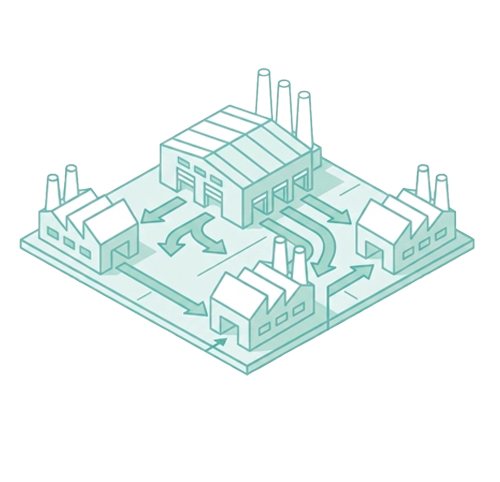
A central warehouse supplies multiple plants or regional subsidiaries
and internal goods movements need to be accurately tracked by the system
![[Translate to English:] Kaufmännische Firmen](/fileadmin/Software_ERP/erp-system-cloud/icons/kaufmaennische_firmen_1.png "[Translate to English:] Kaufmännische Firmen")
Several commercial companies operate with a shared logistics structure
when operational processes are closely integrated, but financial responsibility remains separate
![[Translate to English:] Interne Lieferketten](/fileadmin/Software_ERP/erp-system-cloud/icons/interne_lieferketten.png "[Translate to English:] Interne Lieferketten")
internal supply chains should be managed in a more transparent and automated manner
rather than through manual coordination, siloed solutions, or additional interfaces
![[Translate to English:] Stammdaten](/fileadmin/Software_ERP/erp-system-cloud/icons/stammdaten_1.png "[Translate to English:] Stammdaten")
Master data, inventory, or resources are used across multiple locations
And this requires a consistent ERP model
![[Translate to English:] Gewachsene Standortstrukturen](/fileadmin/Software_ERP/erp-system-cloud/icons/gewachsene_standortstrukturen.png "[Translate to English:] Gewachsene Standorte")
existing site structures should be harmonized or reorganized
for example, as part of an ERP implementation, reorganization, expansion, or migration
Welche Vorteile bietet Infor LN als ERP für Multi-Site-Strukturen?
![[Translate to English:] Lieferkette](/fileadmin/Software_ERP/erp-system-cloud/icons/icon_wege.svg "[Translate to English:] Lieferkette")
Infor LN enables companies to map their internal supply chain within the system—from logistics movements to commercial billing. This makes cross-site processes more consistent and less dependent on manual coordination.
![[Translate to English:] Logistik](/fileadmin/Software_ERP/erp-system-cloud/icons/icon_spediteur.svg "[Translate to English:] Icon Logistik")
A key advantage of Infor LN Multi Site is that it allows a shared logistics structure to be combined with multiple business entities. This keeps financial responsibilities separate while still enabling operational processes to run in close coordination.
![[Translate to English:] Stammdaten](/fileadmin/Software_ERP/erp-system-cloud/icons/icon_stammdaten.svg "[Translate to English:] Icon Stammdaten")
Companies can use resources, inventory, and master data across locations in a shared environment. This reduces redundancies and creates a better foundation for harmonized processes.
![[Translate to English:] Transparenz](/fileadmin/Software_ERP/erp-system-cloud/icons/icon_transparenz.svg "[Translate to English:] Icon Transparenz")
By mapping and automating logistical and financial processes within the system, internal delivery and billing processes become more traceable. Dashboards and reports also help manage intercompany relationships with greater transparency.
![[Translate to English:] Skalierbarkeit](/fileadmin/Software_ERP/erp-system-cloud/icons/icon_skalierbarkeit.svg "[Translate to English:] Icon Skalierbarkeit")
A uniformly designed multi-site model makes it easier to integrate additional locations, subsidiaries, or supply structures into the ERP landscape in a controlled manner. This is particularly relevant for international rollouts, reorganizations, or growth scenarios.
![[Translate to English:] Weniger Systembrüche](/fileadmin/Software_ERP/erp-system-cloud/icons/icon_prozesse.svg "[Translate to English:] Weniger Systembrüche")
When multiple units work closely together, a shared ERP structure is often more efficient than isolated individual solutions with numerous interfaces or manual data transfers. This improves process quality and responsiveness in operational management.
Our Approach: Evaluating Multi-Site Structures in Infor LN from a Process Perspective
In the first step, we examine how the company actually operates: Which locations work together? Where do material flows, decisions, and dependencies arise?
In many organizations, it quickly becomes apparent that the formal organizational structure and the reality of how processes are actually carried out do not align. It is precisely this gap that serves as the starting point for the subsequent multi-site model.
In the next step, we analyze how goods, services, and information actually flow between the units.
This involves specific questions: Who supplies whom? Where do transfers take place? Which business and logistics processes must work together?
The goal is to gain a clear understanding of the actual interdependencies between processes.
A multi-site structure almost always involves a conflict of objectives: uniform global processes versus local requirements.
We actively try to decide: What should be standardized because it improves efficiency? And where do we consciously accept deviations because they are operationally necessary?
Based on this, we develop a target model for the future multi-site structure in Infor LN.
In doing so, we also consider the underlying questions:
- Who will be responsible for master data in the future?
- How will intercompany processes be managed and controlled?
- Where will clear, centralized rules apply, and where will local flexibility remain?
A multi-site model rarely fails because of technical issues, but rather due to a lack of shared understanding.
That’s why we make it a priority early on to make the interconnections tangible—through concrete scenarios, workshops, and tests that reflect real-world work situations.
This results not only in an implemented system, but also in a shared understanding of the operating model across all locations.
FAQ on Infor LN as an ERP Solution for Multi-Site Structures
“Multi-Site” in Infor LN refers to the mapping of multiple locations, warehouses, or organizational units within a single ERP structure. The goal is to integrate internal supply relationships, logistics processes, and business structures within the system.
What matters most is not so much the number of locations as the extent to which they actually collaborate. As soon as locations or companies are closely linked through internal material flows, shared inventory, centralized warehouse structures, or intercompany processes, a multi-site model should be considered.
These include, for example, internal material deliveries, transfers between locations, supplying multiple plants from a central warehouse, or intercompany processes between affiliated entities.
Depending on the initial situation, the impact can be very significant. Responsibilities, approvals, master data processes, or the balance between centralized control and local autonomy often change. For this reason, multi-site implementation should be viewed not only as an ERP issue but also as an organizational change.
The major advantage lies in the end-to-end mapping of internal supply chains and the shared use of processes, inventory, resources, and master data. At the same time, business structures can remain separate, even though operational collaboration takes place within an integrated system.
We will be happy to present solutions for your industry and your processes. Talk to the specialists for SMEs.
request now