
 Infor LN Implementation
 Infor LN Migration
 About us
 Contact
What is the Infor Data Lake?
The Infor Data Lake is the central storage and consumption layer within Infor OS/Data Fabric for data from Infor applications and third-party systems. The key point for projects is that data is stored in a way that allows it to be flexibly used later for various purposes—analytics, process monitoring, integrations, and audit trails.
Why Infor Data Lake Acts as a Multiplier in Cloud Migrations
In LN settings, we often see:
- Heavily loaded operational databases,
- nighttime reporting jobs “at their limit,”
- expanded exports, and shadow ETLs.
With data lake-based consumption, reporting is gradually decoupled. This has two effects:
- Stability (less load/dependencies on LN)
- Release robustness (analytics and exports are less vulnerable to changes in the ERP system).
In discrete manufacturing in particular, LN is often deployed globally. The data lake helps to consolidate data by domain—rather than by plant or table logic—and thus:
- Make KPIs comparable,
- Ensure the quality of master data is transparent,
- Establish comprehensive end-to-end transparency.
Many LN migrations also serve as an “integration overhaul.” The data lake is not a substitute for integration logic, but it does provide a strong foundation for stability:
- Events and data flows are standardized
- Consumers (BI, data science, external systems) access defined data products in a controlled manner,
- and governance and permissions can be managed more centrally.
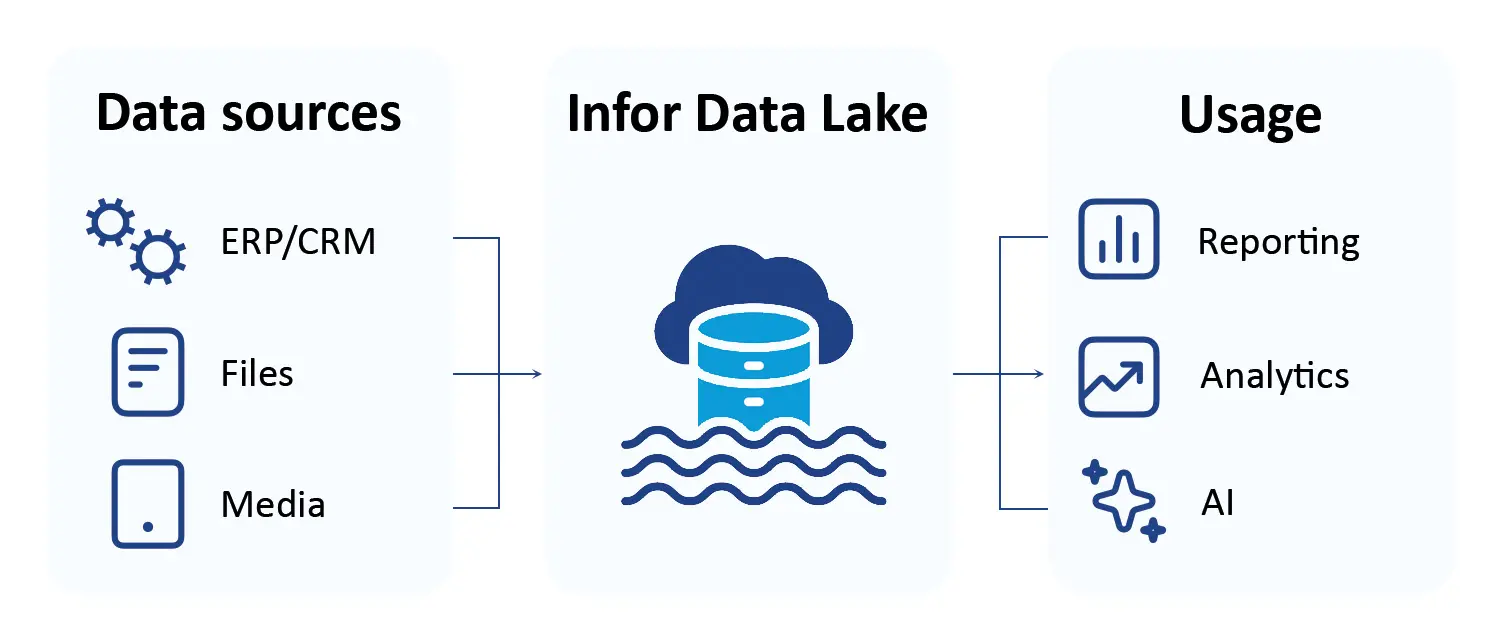
Infor Data Lake in the Infor OS Stack: Architecture Overview
Data Ingestion: How Data Enters the Infor Data Lake
There are several ways to get data into the data lake:
- ION Data Flows/Connection Points as a central integration and data flow mechanism (including for loading data from source systems)
- Ingestion API (programmatic loading of data objects via REST)
- Queue/upload mechanisms
Practical tip for LN migrations:
Plan your data ingestion using a domain-oriented approach (Order-to-Cash, Plan-to-Produce, Procure-to-Pay, Project/Service) rather than a table-oriented one. This reduces the need for rework later on in analytics, data quality, and KPI definitions.
Metadata & Data Catalog: No Catalog, No Scalability
In reality, data lake initiatives often fail due to a lack of direction:
- What is the object?
- Who owns it?
- Which version is valid?
- Which fields are sensitive?
That is why we treat the Data Catalog as an essential component of the design—with clear standards for:
- Naming & Domains
- Ownership (Data Owner/Steward)
- Sensitivity Classification
- Approval Processes
Access & Usage: How Teams Use Data Securely and Efficiently
Consumption is the point at which IT strategy becomes “tangible”
- BI/Analytics access curated datasets,
- the architecture establishes standards for queries, views, and data products
- External consumers use controlled APIs instead of unverified exports
Governance level: Security, retention, auditing
Governance isn't just a chapter at the end of the document. In cloud programs, it's an operating model:
- Roles & Responsibilities
- Access Policies
- Retention/Deletion
- Traceability
Especially when it comes to personal data (GDPR) or IP-sensitive engineering data, the question isn’t “Can the tool do that?”, but rather: Who is authorized to do what, and how is this monitored on a day-to-day basis?
The Infor Data Lake in the phased cloud migration roadmap
- KPI/Use Case Map (Management + Business Units)
- Data Domains, Responsibilities, Sensitivity
- Integration Principles (Standards Instead of Individual Solutions)
- Role Models & Access Concepts
- Catalog Standards (Domains, Naming, Ownership)
- 1–2 prioritized data flows as a blueprint
- Reusable pipeline patterns by domain
- Gold datasets for reporting
- Consumer onboarding (BI, Teams, external systems)
- Self-Service Enablement
- Cost/Performance Tuning
- Retention/Purge as a Routine Operation
We will be happy to present solutions for your industry and your processes. Talk to the specialists for SMEs.
request now