
 Infor LN Implementation
 Infor LN Migration
 About us
 Contact
For which companies is Infor LN Quality particularly relevant?
Wherever:

Initial sample inspections are mandatory

Quality-related standards must be complied with

must result in deviations from structured measures

Quality status impacts logistics and manufacturing
Why we are the right partner for Infor LN Quality

The Quality module is one of the most challenging functional areas in Infor LN, and at the same time one of the least thoroughly mastered.
In addition to our in-depth knowledge of the modules, our strength lies above all in the process-oriented integration of quality into logistics, production, and procurement.
We offer:
- Several years of project experience in implementing the LN quality module
- In-depth expertise in regulated industries
- Experience with complex inspection and nonconformance processes
- Practical knowledge of in-process inspections
- Expertise in the use of sampling plans with dynamic changes in inspection severity
Why are traditional QM solutions reaching their limits?
Many companies use separate CAQ systems, Excel spreadsheets, or paper-based inspection plans. This often leads to:
- Lack of transparency regarding the actual quality status
- Manual blocks and workarounds in the warehouse
- Discontinuous processes due to system disconnects between ERP and CAQ (interfaces, delayed feedback)
- Delayed responses to deviations
- Unclear accountability for errors
- High effort required for audits and documentation
- Lack of a consistent database for quality costs or supplier evaluations
The Solution: Infor LN Quality as an Integrated ERP Module
Infor LN does not view quality in isolation, but rather as an end-to-end process spanning the entire product lifecycle.
Quality checks are automatically generated by the system based on:

Goods Receipts in Purchasing

Production orders and assemblies

In-process inspections

Inventory levels and stock transfers

Sales and Project Deliveries
Added value through integrated quality management
ERP-based quality management delivers business benefits:
- Reduction of unnecessary excess inventory
- Faster replenishment decisions in the event of discrepancies
- Transparent quality costs per item and supplier
- Reduction of manual reconciliations
- Early process stabilization through statistical analysis
- Audit readiness without separate subsidiary ledgers
Features of the Infor LN Quality Package
Test types
- Incoming goods inspection for purchasing and in-house manufacturing
- In-process inspection
- Outgoing goods inspection prior to shipment
- Inventory inspection (periodic or ad hoc)
- Initial sample inspection
For example, newer cloud releases enable ad hoc inventory checks—damaged items can be sent directly for quality inspection.
Test definition
Exams are based on:
- Characteristics (quantitative or qualitative)
- Aspects
- Quality groups
- Sampling procedures
- Acceptance and rejection criteria
Target and actual values are automatically checked against tolerance limits.
Infor LN supports professional sampling procedures:
- Sampling plans with acceptance and rejection criteria
- Classification of characteristics (critical, major, minor)
- Dynamic adjustment of inspection intensity
- Skip-lot logic and rotation rules
Example: If several batches in a row are found to be defect-free, the inspection frequency can be reduced or temporarily suspended—without compromising quality control.
The central control unit is the Non-Conformance Management Report (NCMR).
It enables:
- Documentation of the causes of defects
- Decisions on disposition (rework, scrapping, return shipment)
- Conversion into other items (new specifications)
- In-house repair
- Engagement of external service providers
- Passing on costs to suppliers
In the latest releases, linked defect reports can be created—multiple defects related to the same component are consolidated in a structured manner.
Optionally
- a supplier complaint can be initiated via the purchasing module
- a service request is generated
In regulated industries in particular, initial sample inspection is a critical process.
Infor LN supports:
- Conducting and documenting initial sample inspections
- Conformity report reviews (supplier certificates)
- System, design, and process FMEA
- Calculation of the Risk Priority Number (RPN)
- Development of specific corrective actions
FMEA can be directly integrated into the engineering change process (ERO) and linked to action plans.
The module provides comprehensive reports:
- Product Quality Statistics
- Rejection Statistics by Attribute
- Defect Frequency Over Time
- PPM Analyses
- Process Control for Individual Attributes
Example: If a measured value on an injection molding machine continuously approaches a limit value, adjustments can be made early on—before defective parts are produced.
Quality data thus becomes an active control tool.
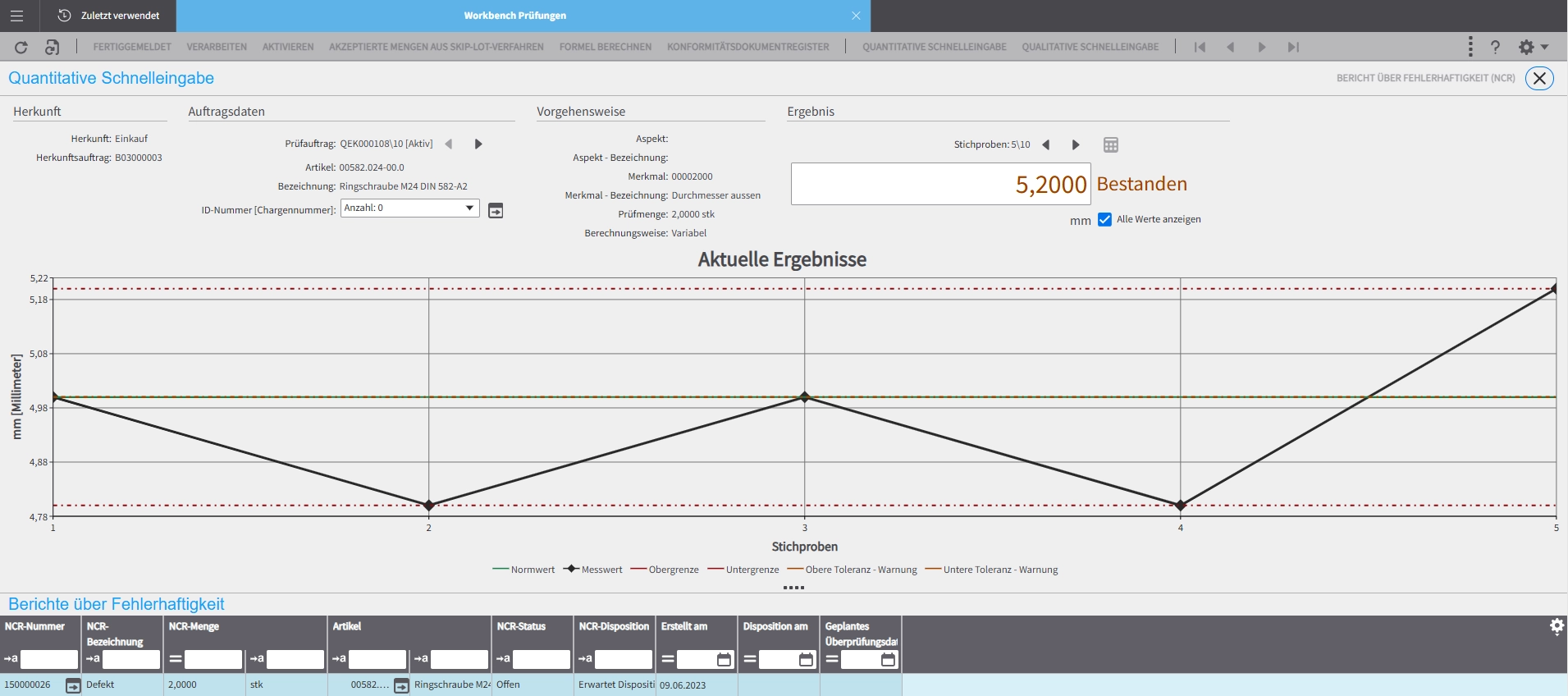
Quality inspections in Infor LN are managed through inspection orders. These can:
- Be order-specific or generally applicable
- Be generated automatically or manually
- Be edited centrally via workbenches
Quality inspections can be performed on a batch-by-batch or serial-number basis. This ensures complete traceability from receipt of goods through to shipment.
Workbenches offer:
- Clear status overviews of open, locked, or pending items
- Structured quick entry fields for inspectors
- Graphical representations of inspection volumes and results
Quality data can be used for trend analysis, defect rates, or PPM evaluations. This makes it possible to systematically identify quality costs and opportunities for improvement.
All inspection results, status changes, and corrective actions are logged in the system. Inspection orders can be traced back to their original logistical source (e.g., purchase order or production order).
Responsibilities for approvals, holds, or corrective actions can be assigned at the organizational level. This results in a clearly defined quality process without informal workarounds.
Structured reports on defect rates, nonconformities, action statuses, or supplier performance are available for internal and external audits.
Practical examples from projects
- Factory acceptance inspections conducted directly at the supplier’s facility
- Weld inspections performed during production with controlled rework
- Reopening of welds instead of scrapping entire assemblies
- Dynamic inspection severity levels in series production
- System-supported allocation of quality costs to suppliers
FAQ: Frequently Asked Questions About Infor Quality Management
Deviations can be recorded as NCMR and linked to disposition decisions (rework, scrap, return). This information can be incorporated into supplier evaluations and forms the basis for data-driven supplier development.
Yes. All inspection orders, characteristics, status changes, and actions are logged and can be traced back to their original source. This allows inspection chains to be documented transparently.
Quality metrics such as defect rates, complaint rates, or PPM can be analyzed directly using ERP data. Since purchasing, production, and quality all use the same data source, there are no inconsistencies between operational figures and reporting.
Regulatory requirements can also be supported by the system through characteristic definitions, sampling logic, historical data tracking, and traceability (e.g., serial or batch reference). A well-defined process configuration during the implementation project is crucial in this regard.
We will be happy to present solutions for your industry and your processes. Talk to the specialists for SMEs.
request now